
🚀 Quick Summary: In 2026, AI-driven phishing and "smart" spam threaten your digital identity. Learn why legacy 10-minute emails are failing and how "Generation 3" services like persistent, cloud-synced disposable emails offer the protection you need.
- 🔹 Focus: Digital Identity Security
- 🔹 The Threat: AI Phishing & Inbox Espionage
- 🔹 The Solution: Generation 3 "Smart" Disposable Email
- 🔹 Recommended Tool: etempmail.org
As we navigate the digital landscape of 2026, your primary email address has evolved into something far more dangerous than a simple communication tool—it has become your "digital fingerprint". Every app, newsletter, and e-commerce store demands this key to enter their front door, but handing it over exposes you to a triad of threats: data breaches, aggressive spam, and sophisticated profiling.
For years, users relied on basic "10-minute mail" services to dodge spam. But in an era where AI can generate convincing phishing attacks in seconds, the old "throwaway" model is obsolete. Enter the era of Generation 3 (Gen-3) disposable email services—and this is where etempmail.org steps in to secure your inbox.
The New Threat: AI Phishing and "Smart" Spam
Why is hiding your real email critical in 2026? Cybersecurity experts warn that the threat landscape has shifted dramatically:
🤖 AI-Driven Phishing
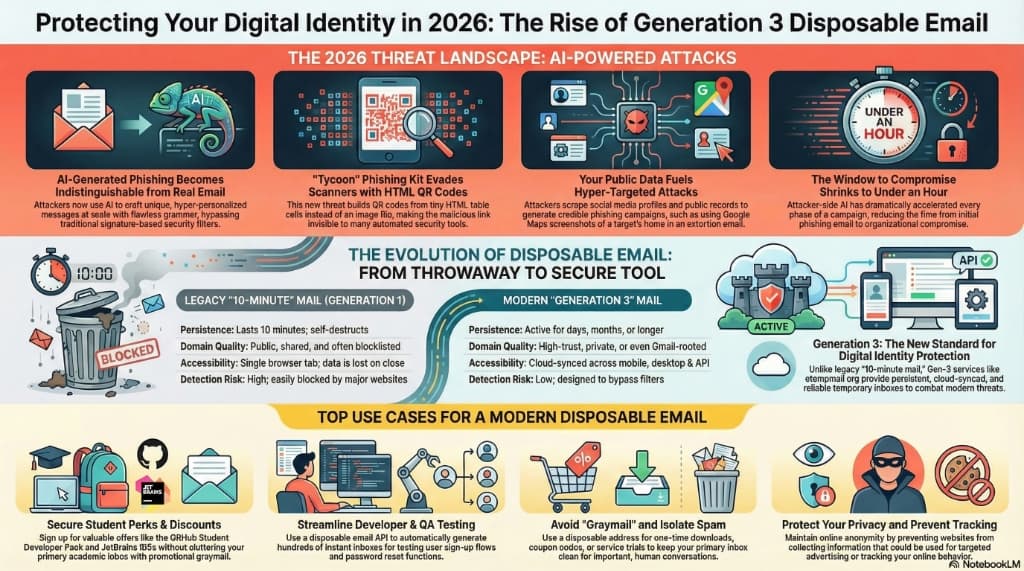
Phishing is no longer just about poorly spelled emails from "princes." By 2026, attackers are using AI to craft hyper-personalized messages that evade standard security gateways.
👁️ Inbox Espionage
Marketers now use AI to "read" your emails before you do, summarizing content and tracking your behavior to optimize open rates.
The "Tycoon" Tactics
New threats like the "Tycoon phishing kit" use QR codes built from HTML tables to bypass detection, or fake browser windows that look exactly like legitimate login pages to steal your credentials.
Using a service like etempmail.org acts as a firewall, keeping these sophisticated AI threats and tracking pixels isolated from your personal and financial data.
What is "Generation 3" Temp Mail?
Legacy disposable emails were fleeting and unreliable—often disappearing before you could even click a verification link. etempmail.orgembraces the "Generation 3" standard, which solves the flaws of the past:
- 1Persistence (The End of "Time Anxiety")
Traditional services deleted emails after 10 minutes. Gen-3 services allow you to keep an address active for days or even months. This ensures you never get locked out of an account because a verification code arrived an hour late.
- 2Cloud Synchronization
Modern users switch between devices constantly. Gen-3 architecture allows you to access your disposable inbox across mobile and desktop interfaces seamlessly.
- 3High-Trust Domains
Many websites block old temp mail domains. Advanced services now utilize high-trust infrastructure (often mimicking standard providers like Gmail) to ensure your disposable address is accepted by major platforms like Facebook or Nike.
Top Use Cases for etempmail.org in 2026
Beyond privacy, a robust disposable email tool is essential for accessing the modern web:
🎓 Student Perks & Discounts
Students can access incredible tools like the GitHub Student Developer Pack, JetBrains IDEs, and Figma simply by verifying a student status. Using etempmail.org allows you to sign up for initial newsletters and offers without cluttering your academic inbox.
💻 Developer & QA Testing
Developers use disposable email APIs to test sign-up flows and password resets automatically. Instead of manually creating 100 Gmail accounts, you can generate instant inboxes for testing purposes.
🛡️ Avoiding "Graymail"
"Graymail" refers to newsletters and notifications you technically signed up for but don't actually want. By using a disposable address for one-time downloads (like whitepapers or coupon codes), you keep your primary inbox clean for human conversation.
Conclusion
The digital citizen of 2026 must be as adept at managing their ephemeral identities as they are at protecting their permanent ones. Your email address is the key to your digital life—do not hand it out to strangers.